


You earn money on OnlyFans—or want to start—and are wondering what the tax office wants to know about it? You're not alone. For many creators, taxes are the topic that gets put off the longest. Understandable, but risky.
Since the DAC7 directive came into effect, platforms such as OnlyFans automatically report your earnings to the EU tax authorities. So the tax office knows whether you report it or not. The good news is that it's less complicated than you think. You just need to know what to do and actually do it.
As an OnlyFans agency, we help creators build their businesses every day—and that includes the tax side of things. In this guide, we'll show you step by step what your obligations are, how to register your business, what taxes you'll have to pay, and what you can deduct from your taxes. Everything is explained in an easy-to-understand way, even if you have no prior knowledge. If you want to learn more about how you can earn money on OnlyFans, you'll find a separate guide on this topic.
Evole Studio is an OnlyFans management agency and not a tax consulting firm, law firm, or auditing company. The contents of this article are for general and non-binding information purposes only. They do not constitute tax, legal, or economic advice and cannot replace individual advice from a qualified tax advisor, auditor, or lawyer.
We do not guarantee the accuracy, completeness, or timeliness of the information provided. Tax regulations are subject to change at any time. All information is based on the status known to us as of February 2026 and applies exclusively to the situation in Germany.
Our clear recommendation: Always consult a tax advisor for your individual tax situation—ideally one with experience in the field of creators and online businesses.
1. Am I liable for tax on OnlyFans? The short answer
2. Registering a business – step by step
4. What can I deduct as business expenses?
5. Calculate OnlyFans earnings correctly
6. Building up tax reserves – how much should you set aside?
7. The 5 most common tax mistakes made by OnlyFans creators
9. Frequently asked questions about OnlyFans and taxes
10. Conclusion
Yes. From the first euro you earn regularly and with the intention of making a profit on OnlyFans, you are liable for tax in Germany. There is no de minimis limit and no "that doesn't count yet." As soon as you regularly create content and get paid for it, you are running a business from a tax perspective.
This applies to all types of income on the platform: subscription income, pay-per-view content (PPV), tips, custom content, and paid messages. Even if you only use OnlyFans as a side gig—alongside your main job or studies—this does not change your tax liability.
DAC7 Directive since 2023: Platforms such as OnlyFans are legally required to report your earnings to the EU tax authorities. The tax office automatically finds out how much you have earned. Concealing income is therefore not only illegal, but also futile.
This may sound intimidating at first. But don't panic—if you get yourself organized early on, the whole thing is manageable. In most cases, the fear of the tax office is greater than what you actually have to deal with.
Registering your business is the first official step. It sounds bureaucratic, but in most cases it can be done in a single morning.
As soon as you start earning regular income on OnlyFans or want to start doing so. In theory, you have to register your business before you earn your first income. In practice, many creators register their business retroactively—the tax office tolerates short delays as long as you register on your own initiative. The longer you wait, the more problematic it becomes.
You register your business with the trade office in your municipality or city. The cost is between €30 and €60, depending on the municipality. In many cities, this can now be done online. You will need your identity card and to fill out a simple form. As your activity, you enter something like "content creation" or "online content production."
After registering your business, the tax office will send you a "tax registration questionnaire" – or you can submit it directly via ELSTER (the online portal of the tax authorities). Here you enter your estimated income, select the small business regulation if applicable, and specify whether you want to opt for sales tax. Tip: It is better to estimate your income conservatively. Overestimating will result in high advance payments.
Good news: You can run your business under your stage name. Only the tax office and the trade office know your real details—not your subscribers. If anonymity is important to you, read our guide to anonymity on OnlyFans, where we cover the topic in detail.
In 95% of cases, the tax office classifies OnlyFans creators as traders. Freelance work only applies if your work is clearly classified as "artistic" in the tax law sense—which is not the case for most OnlyFans content. The difference: as a business owner, you pay additional trade tax (but only on profits above €24,500 per year). In practice, this makes little difference for most creators.
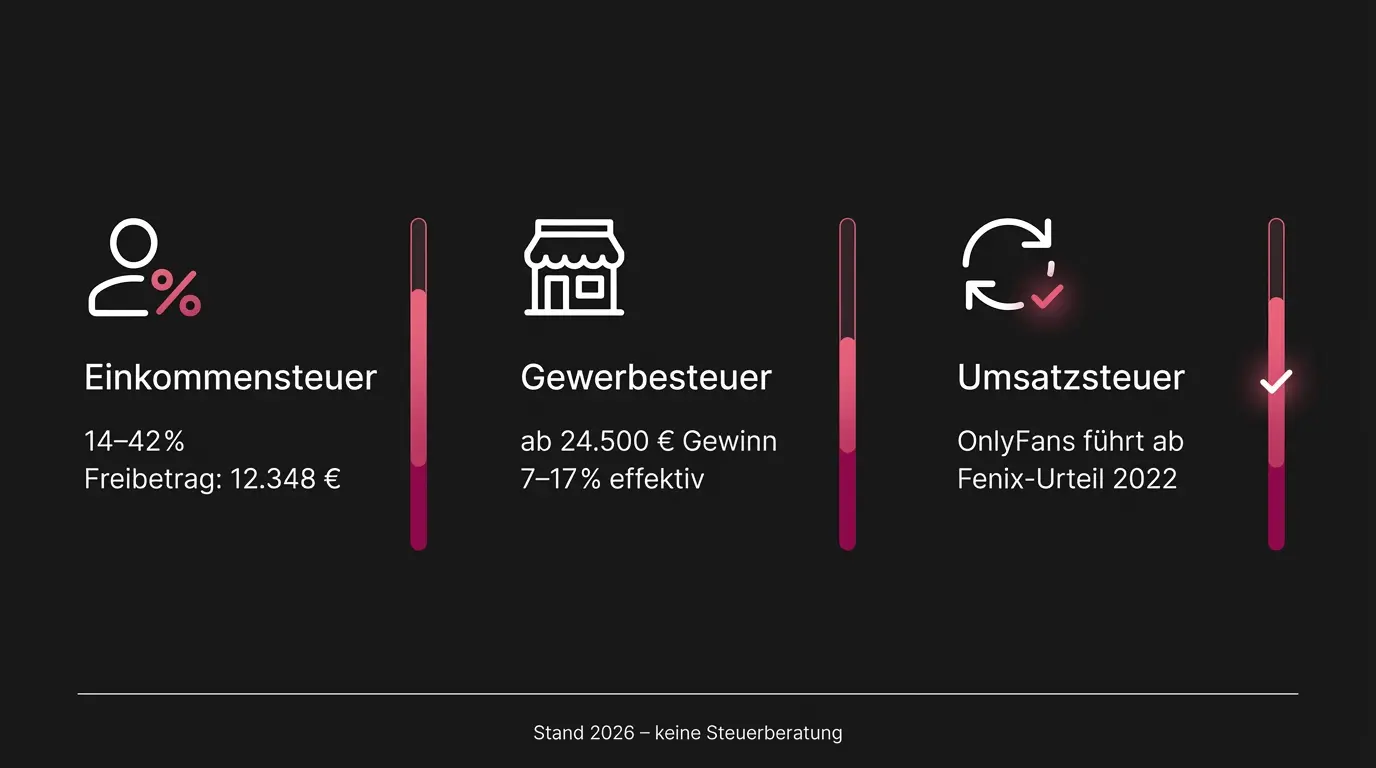
As an OnlyFans creator, there are basically three types of taxes to consider. Not all of them necessarily apply to you—it depends on your income level.
Income tax is the most important tax for you. It is levied on your total profit—i.e., income minus operating expenses. The tax rate is progressive: the more you earn, the higher the percentage.
Key figures for 2026:
In addition, there is the solidarity surcharge (5.5% of income tax, but only for higher incomes) and, if applicable, church tax (8–9% of income tax).
Trade tax is only payable on annual profits above €24,500. Below this amount, you are completely exempt. If you exceed this amount, trade tax is partially offset against income tax, so the actual additional burden is lower than many people think. The assessment rate varies depending on the municipality—in most cities, the effective tax burden is approximately 7–17% on profits above the exemption amount.
This is where it gets a little more specific: According to the ECJ ruling on the Fenix decision (2022/2023), OnlyFans is considered an electronic service provider that provides services to end customers in its own name. This means that OnlyFans pays the sales tax on your earnings itself. As a creator, you are not liable for sales tax on these earnings.
In plain language, this means that you do not have to calculate and pay sales tax on your OnlyFans income. However, you must inform your tax office about this special regulation and have them confirm that it applies in your case. If you paid sales tax yourself before the ruling, you can check whether a refund is possible.
Important: The sales tax exemption only applies to income earned through OnlyFans. If you also sell your own products, offer coaching, or earn income through other platforms, the normal sales tax rules apply.
The small business regulation (§ 19 UStG) exempts you from sales tax as long as your turnover in the previous year was less than €25,000. Since OnlyFans pays the sales tax itself anyway, the small business regulation is less relevant for pure OnlyFans income than for other businesses. However, it can be useful if you have other sources of income besides OnlyFans. It is best to discuss this with your tax advisor.
Operating expenses reduce your taxable income—and therefore your tax burden. As an OnlyFans creator, you can deduct more than you might think. Here is an overview of the most common items:
Camera, lighting, microphones, tripods, smartphone, and laptop (proportional for mixed use, e.g., 60–80% business). Devices costing more than €800 net are depreciated over several years.
Lingerie, costumes, outfits, and props that can be proven to have been used for content. Tip: Document their use with screenshots or photos of the content. Everyday clothing cannot be deducted.
Studio rental for photo shoots or the home office allowance (€6/day, max. €1,260/year) if you work from home. If you have a separate study, you can deduct the proportionate rental costs.
Internet and cell phone contract (proportionate), image editing software, VPN subscriptions, planning tools, cloud storage. Agency fees, management costs, marketing expenses, and travel costs for shoots are also tax-deductible.
Makeup, hair salon visits, and cosmetic treatments are tax-deductible if they can be proven to be used for content production. The tax authorities are stricter in this regard—make sure to document the connection carefully.
Keep all invoices and receipts for at least 10 years. Digital copies are sufficient, but ensure that the files are legible and complete. Without a receipt, there is no deduction. A simple folder structure organized by month helps you keep track of everything.
This is where many creators stumble: OnlyFans retains a 20% commission and only pays you 80%. However, 100% of your income is relevant for your tax return, not just the 80% that is paid out.
How it works from a tax perspective:
Although a separate business account is not mandatory, it is highly recommended. It clearly separates private and business finances and makes tax returns much easier. Many online banks offer free business accounts.
As an agency, we not only support our creators with content and marketing, but also help with organizational issues related to the business. So you can focus on what you do best.
Apply now without obligationOne of the most common mistakes: Creators spend everything and have no money left at the end of the year to pay their back taxes. This can easily be avoided.
Rule of thumb: Set aside 30% of your monthly profit as a tax reserve. In most cases, this will cover income tax, trade tax, and solidarity surcharge. It's better to set aside a little more—whatever's left over is a nice bonus.
Here is a sample calculation:
Gross income on OnlyFans: approx. €4,700/month
Minus 20% OnlyFans commission: -€940
Less additional operating expenses (approx. €760): equipment, software, etc.
Profit: approx. $3,000/month = $36,000/year
Income tax (approx. 20% effective for this income): approx. €5,500/year
Trade tax (36,000 – 24,500 = 11,500 × approx. 14%): approx. 1,600/year
Tax reserve per month: approx. $600–900 (depending on municipality and personal circumstances)
Especially in the first year, you may be surprised by a tax back payment. The tax office only determines advance payments after the first tax return—until then, a year's worth of tax liabilities accumulates. Those who have not made provisions for this will quickly find themselves facing a problem.
From our experience as an agency, we see the same mistakes over and over again. Here are the top 5—and how you can avoid them:
1. Don't register a business at all and hope that no one notices.
The most common and dangerous mistake. Since DAC7, OnlyFans automatically reports your earnings. The tax office will come after you—and then it will get expensive: back payments, interest, and, in the worst case, proceedings for tax evasion.
2. Not declaring all income
Many people forget about tips, custom content, or revenue from paid messages. Everything that comes in via OnlyFans counts. Check your OnlyFans statements monthly and enter all revenue accurately.
3. Do not keep receipts
Bought a new camera but didn't keep the receipt? Then you can't claim it as a tax deduction. Scan or photograph every invoice immediately and save it digitally. It takes 30 seconds and could save you hundreds of dollars.
4. Do not build up reserves
Many people are caught off guard by tax back payments in the first or second year. Set up a standing order: 30% of your profits to a separate tax account. Automatically, every month.
5. Ignore special sales tax regulations
Since the Fenix ruling, OnlyFans has been paying sales tax—not you. But you must inform your tax office about this. If you fail to do so, you risk the tax office assessing you for sales tax anyway. Clarify this at an early stage.
The honest answer: yes—at the latest when your monthly income reaches four figures. And even before that, it can be a good idea to seek advice at least once.
A tax advisor costs money (expect to pay between €80 and €250 per month, depending on the scope of services), but usually saves you more than they cost. A good tax advisor:
Our tip: Look for a tax advisor who has experience with creators, influencers, or online businesses. Not every tax advisor is familiar with the specifics of platform income. Ask them directly—a good tax advisor will be honest if the topic is not within their area of expertise.
Professional tax advice has become standard among German OnlyFans creators —precisely because the tax situation has become more complex due to international platforms and EU directives.
As soon as you regularly generate income with the intention of making a profit, you are liable for tax—from the very first euro. The basic allowance of €12,348 (2026) simply means that no income tax is payable up to this limit. However, you are still required to register your business.
No. Since the DAC7 directive (2023), platforms such as OnlyFans automatically report your earnings to the tax authorities. Concealing earnings is tax evasion and is punishable by additional payments, interest, and, in the worst case, criminal consequences.
Yes, as soon as you generate income regularly and with the intention of making a profit, you are required to register your business—regardless of the amount. However, you only pay taxes if your annual profit exceeds the basic allowance.
The tax office will usually tolerate a short delay if you report it yourself. Longer delays may result in additional payments and late fees. The sooner you report it, the better. Retroactive registration is generally possible.
Yes, if you can prove that they are used exclusively or predominantly for content production. Document this with screenshots of your content. Everyday clothing and everyday care products are not tax-deductible. Tax offices are particularly strict when it comes to cosmetics – keep your receipts and proof of business use carefully.
Not usually for income earned through OnlyFans. Since the ECJ ruling on the Fenix decision, OnlyFans has been paying sales tax itself. However, you must inform your tax office about this regulation and have it confirmed. The normal sales tax rules apply to income earned through other channels.
With an annual profit of €36,000, income tax amounts to approximately €5,500 per year (effective tax rate approx. 15–20%). In addition, there may be trade tax on the amount above €24,500 (approx. €1,600). This amounts to a total of around €7,000–8,000 per year, depending on the municipality and personal circumstances. This corresponds to monthly reserves of approximately €600–700.
It is less relevant for pure OnlyFans income, as OnlyFans pays the sales tax itself anyway. However, if you have other sources of income in addition to OnlyFans (e.g., your own merch shop, coaching, or other platforms), the small business regulation may be useful for sales under €25,000 in the previous year. Get individual advice here.
Taxes aren't the most exciting part of being a creator. But ignoring them isn't an option—and the good news is that once you get yourself set up properly, the rest almost takes care of itself.
The most important steps summarized: Register your business, inform the tax office about the special VAT regulation, collect receipts, set aside 30% as a reserve, and find a tax advisor with Creator experience. This will cost you a few hours of effort at the beginning—and save you stress, additional payments, and sleepless nights in the long run.
And remember: doing your OnlyFans taxes correctly in Germany is not only an obligation—it's also a sign that you take your business seriously. If you run your business properly, you can invest in growth with greater confidence.
As an OnlyFans agency, we not only help creators with content and marketing, but also provide support with organizational issues relating to trade and business development. Focus on your content—we'll take care of the rest.
Apply now without obligation